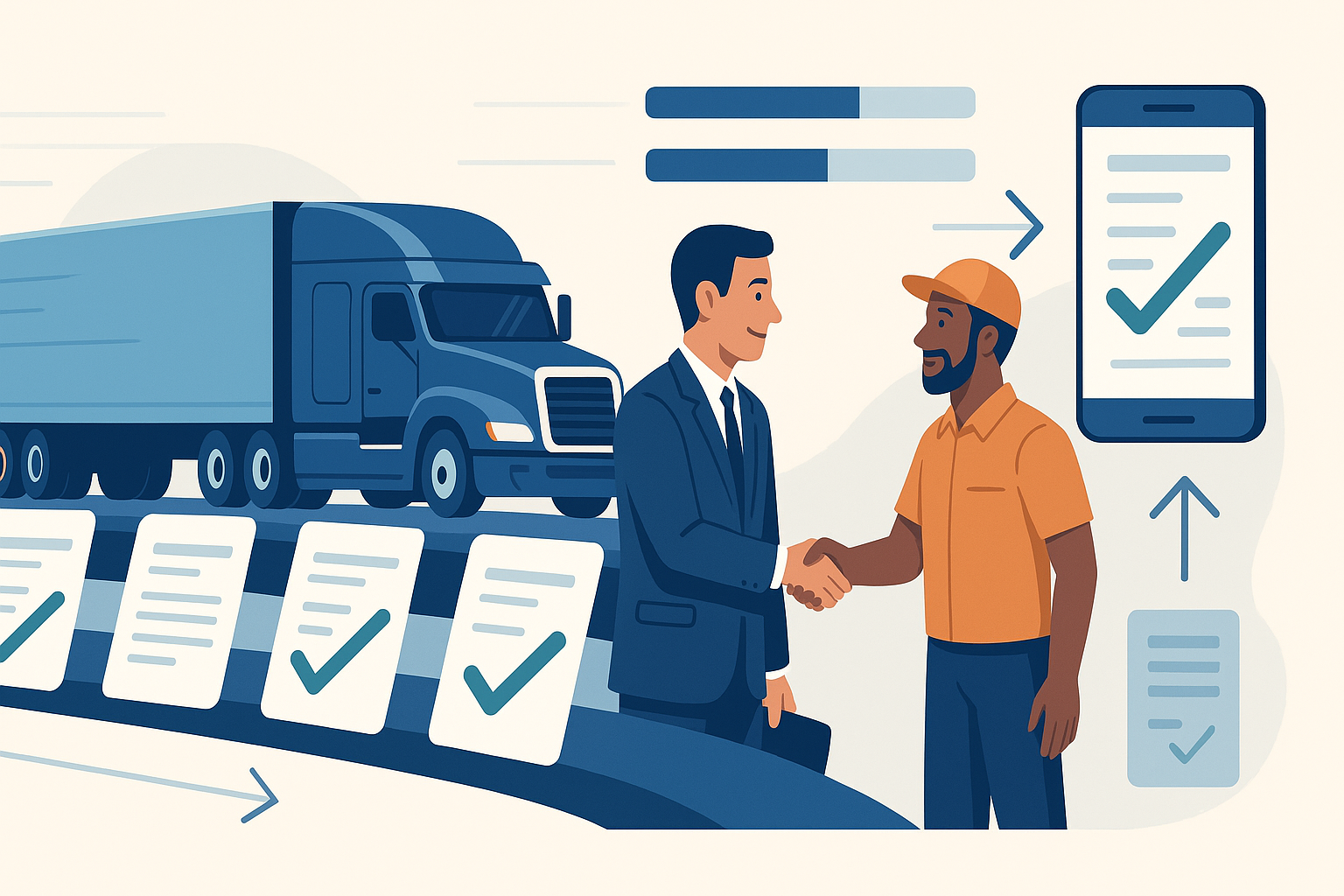
In this tight transportation market, truck driver recruiting is a crucial challenge for fleets. Carrier companies struggle to keep fully manned trucks due to the inadequate number of drivers. Recruitment and onboarding delays result in more idle trucks, less satisfied customers, and more costs. You can achieve this by streamline every step in the driver hiring onboarding process, starting with signing on qualified teams and finishing with safety training. We will discuss the steps, tools, and future trends to transform your driver recruitment and onboarding into an advantage to compete with other companies.

Sketch Your Current Recruitment Workflow
Before you alter your workflow, it is important to have perceptibility into each step involved:
- Job Posting to Application: Discover how long it takes drivers to see and submit your openings.
- Application to Screening: Check if there are hurdles in resume review, background checks, and qualification verification.
- Screening to Hiring Decision: Note hours spent on interviews (phone, video, and in-person) and final approvals.
- Hiring to First Day: Write down if there is any delay in paperwork or training before drivers go on the road.
By forming a map of these steps, you can discover where candidates fall off, which paperwork stacks up, and where automation or simplification can take place.
Optimize Your Application Process

A long application form can deter potential talent. Make it lean and mobile-friendly:
- Minimal Required Fields
Just ask immediately necessary questions — the driver’s name, contact, license number, years of experience, etc. An overabundance of questions or long forms result in drop-off, especially on mobile devices. - Pre‑Qualification Filters
Insert simple yes/no checks at start like “Are you in possession of a valid CDL?” and “Have you been accident-free for the last two years?” Those candidates that do not meet these criteria will not waste your or their time. - One‑Click Apply
Invite social media login options (e.g., LinkedIn) that let drivers upload a résumé that auto‑fills fields. This convenient experience can increase application completion by 30%. - Real‑Time Feedback
Allow candidates to see a progress bar or send confirmation emails. Trust can be established through transparency, which encourages them to finish the process.
Use Technology for a Fast Track Screening
Automating initial hiring screens frees you to focus only on the most qualified applicants:
| Technology | Purpose | Benefit |
| Applicant Tracking System (ATS) | Accumulate all applications and resumes | Boost review speed, standardize candidate pipelines |
| Video Interview Platforms | Conduct remote interviews | Accelerates the first screening, cuts travel costs |
| Digital Credential Verification | Verify licenses and endorsements | Guarantees statutory FMCSA and state compliance at an early stage |
| Background Check Services | Automate criminal and driving history | Cuts turnaround times from days to hours |
| Onboarding Software | Automate paperwork and training modules | Reduces manual data entry and duplication |
Recent ATS prototypes are versatile: they can read résumé data, rank candidates in accordance with your rules, & can also send automated interview invites. Video interview platforms allow you to record the responses online, which makes it easy for hiring managers to plan around their busy schedules. Moreover, digital credential versions will check (like the license, endorsements, and drug tests) that everything is okay before the orientations start and this will help avoid costs and delays.
Design an Immersive Onboarding Experience

Upon hiring drivers, a superior first impression will capitalize on retention and performance:
- Pre‑Boarding Communication
Send’.e mails as welcome messages which are clear on paperwork, orientation schedules, and contact persons. Videos introduce the safety meal team with a day-in-the-life diary — this human touch reduces fears on the first day. - Digital Paperwork
Please make use of e-signatures and online forms for tax documents, benefits enrollment, and company policies. Paper packets consume a lot of time and contain a lot of errors; digital forms help to reduce the processing time by more than 50%. - Structured Orientation Modules
Divide training into small bits of e-learning like modules covering company culture, safety protocols, and industry best practices. Mobile-friendly modules give drivers the chance to finish sessions at their own pace before they arrive. - Mentorship Pairing
Link new hires with experienced drivers as their “onboarding buddies.” They will get tips like route planning, logbook maintenance, and customer interactions that are very useful and no other learning methods can provide. - Performance Milestones
Provide accessible checkpoints that can be determined by achieving outcomes without any accidents, such as completing 5 runs without incident or mastering ELD usage. Celebrating these victories with recognition or small rewards not only motivates new drivers but also helps to develop good manners.
Partner with Specialized Recruitment Platforms
General job boards are often flooded with the applications of people who do not have a CDL. Teaming up with sector-specific job boards and operational platforms, such as Trucking Talent, will connect you with qualified drivers who have passed screening:
- Gain Access to Industry-Focused Talent Pools
Truck-related platforms channel specialists who understand the complexities associated with long-distance and local operations. - Advantages as a Featured Employer
Some services provide premium listings, targeted email blasts plus candidate referrals, thus speeding up the sourcing phase. - Screening as a Package
Platforms would sometimes include credential checks, assessments, and training certificates, thus you get only those candidates who are fully qualified.
Integrating these specialized channels into your sourcing strategies will go a long way in improving candidate quality and shorten time-to-fill.
Monitor, Measure, and Refine
Even the most efficient processes require continuous adjustment:
- Main Metrics
- Time-to-hire: Minutes spanning the time it takes to get the application signed and then the offer accepted
- Time-to-onboard: Minutes expended from the time the offer is accepted until the first paid shift occurs
- Offer acceptance rate: Number of offers that are signed divided by the total number of offers sent
- First-month retention: Number of drivers kept active after 30 days
- Time-to-hire: Minutes spanning the time it takes to get the application signed and then the offer accepted
- Feedback Loops
Seek the views of newly employed after 1 week and 1 month about their onboarding experience. What was their perception? What parts did they find redundant? Leverage these insights to get rid of friction. - A/B Testing
For instance, deploying various email templates, orientation schedules, or form layouts and comparing the resultant completion rates is a bright idea. Little alterations can lead to outstanding changes in candidate satisfaction. - Benchmark Against Peers
The American Trucking Association reports that top fleets hire and onboard drivers up to 20% faster than the industry average. Set out to match or surpass these standards.
Keep Up with Emerging Trends
The transformation of the transportation and recruiting industries is quite fast. You can stay ahead by:
- Mobile-First Tools
A greater part of the drivers use smartphones to find jobs. Ensure that every portal, application, and training module is mobile-friendly. - AI‑Powered Screening
Artificial intelligence can detect communication skills through the analysis of video recording, flag high-risk behaviors in drivers, and find language patterns that are indicative of cultural fit. - Virtual Reality (VR) Training
Cutting-edge carriers have a trial run game, “ride-along” simulation; this is a virtual reality experience where recruits experience what it is like to drive in adverse conditions before going on their first trip. - Integration with FMCSA Clearinghouse
Access to real-time drug and alcohol violation records helps in the onboarding of only compliant professionals.
By using these innovations, you will not only shorten the hiring cycles but also improve the candidate experience. As a result, your company will be a good place for them to pursue their career — and you’ll be able to easily hire truck driver who fit your needs.
Final Thoughts
The process of truck driver hiring optimization is a journey that you take as a long-term commitment to efficiency, compliance, and an excellent driver experience. It can be initiated by first documenting your process, embracing technology for faster onboarding, and using specialized platforms like Trucking Talent to recruit skilled workers from the desired talent pool. You can also include structured mentorship, digital training, and data-driven refinement as complementary tools for realizing your objectives. As a result, you will have no problem creating a pipeline of top-notch drivers, standing by, and ready for the first trip. The ongoing adaptation of your company to the ways it introduces new tools and methods will keep your fleet, customers, and your recruiting costs in check.
FAQ
- How long does the truck driver hiring process usually take?
Trucks typically take about 30–45 days to complete the process of hiring drivers, automated screening, and digital onboarding, which can reduce the time by a week. - What tools speed up initial driver screening most effectively?
The most significant tools would thus be Applicant Tracking Systems, digital credential verification, and automated background‑check services; these can totally shortcut the long wait of days to mere hours. - How can I improve candidate experience during onboarding?
Deployment of a systematic and mobile‑friendly application, giving real‑time progress feedback, as well as pairing of recruits with veteran “onboarding buddies” are the solution to increasing transparency and support for them. - Can pre‑boarding videos reduce first‑day anxiety for new drivers?
Definitely! Short welcome messages that introduce safety teams and day‑in‑the‑life scenarios give a head start to the students and help them feel relaxed on the first day. - Should FMCSA Clearinghouse integration be prioritized early in the process?
For sure! The Clearinghouse checks done pre‑orientation will ensure compliance and thus will not present any last‑minute costly disqualifications. - How does pairing new hires with veteran drivers impact retention?
The mentorship is the one that creates peer support and genuine guidance, all that leading to less turnover and stronger long‑term attachment. - Which emerging trend will most influence trucking recruitment in 2025?
Aside from the already existing one, the new trend will be AI‑driven video initial screening that will, as well as assessing communicational capabilities, catch high‑risk behaviors. - Why is tracking first‑month retention crucial and how can you improve it?
Understanding the retention aspects of onboarding helps identify areas needing work, so they should ask for feedback at both week one and month one which would help find the friction prior to fixing it.



Leave a Reply